

At a Glance: AI resume screening is here to stay, but it works best when both sides understand its limitations. Job seekers should optimize their resumes for AI systems without losing authenticity, and hiring managers should pair AI screening tools with human review to avoid filtering out qualified candidates.
Artificial intelligence has changed the recruitment process across the United States. AI resume screening tools now handle initial screening for a growing number of employers, sorting through large applicant pools in seconds. But this speed comes with trade-offs. Qualified candidates get filtered out by rigid AI algorithms, and generative AI is making resumes harder to evaluate on both sides.
How AI Resume Screening Works
Most AI screening systems operate as part of an applicant tracking system (ATS). When a job seeker submits a job application, the AI tool scans the resume for relevant keywords, work history patterns, and formatting signals. It then ranks candidates based on how closely they match the job description.
Here is what the AI system typically evaluates during initial screening:
- Relevant keywords that match the job posting
- Job titles and work experience timelines
- Education and certifications listed in bullet points
- Formatting and structure (simple layouts score higher)
- Gaps in employment or unconventional career paths
According to a Harvard Business School study, automated resume screening filters out more than 88% of qualified candidates. That number affects everyone in the hiring process, from the job seeker who never gets a callback to the hiring team that misses out on top talent.
For Job Seekers: Should You Use an AI-Assisted Resume?
Using an AI tool to help draft or polish your resume is fine, but submitting a fully AI-generated resume without edits can hurt your job search. Hiring managers are getting better at spotting generic, AI-written content. The goal is to use AI as a starting point, then make the resume your own.
Optimize for the ATS Without Losing Your Voice
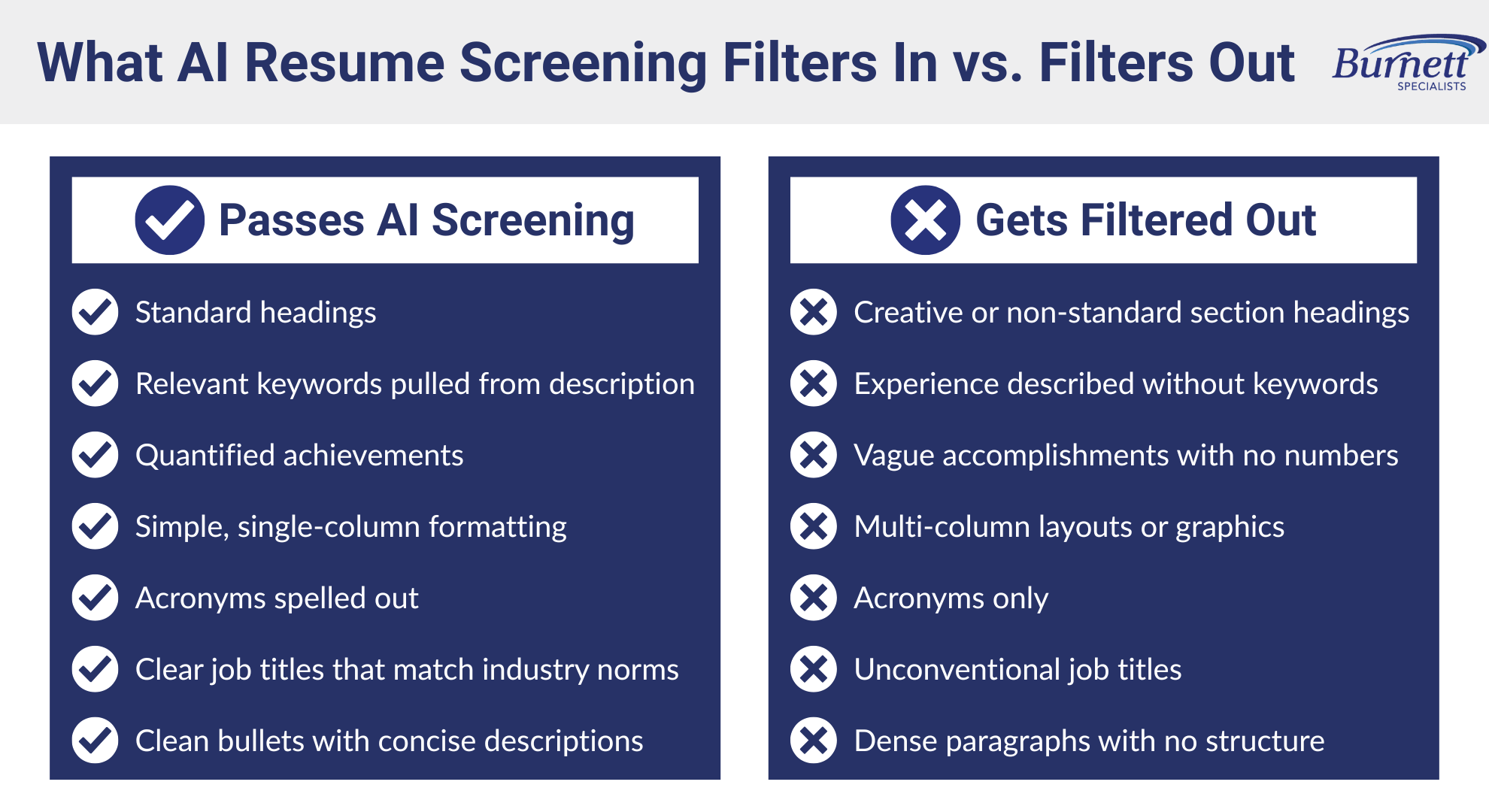
- Pull relevant keywords directly from the job description and work them into your experience sections naturally
- Use standard headings like “Work Experience,” “Education,” and “Skills” so the AI system can parse your resume correctly
- Keep formatting simple. Avoid columns, graphics, and text boxes that confuse applicant tracking systems
- Spell out acronyms at least once (e.g., “Project Management Professional (PMP)”)
- Quantify achievements with numbers instead of vague descriptions
Make Your Resume Stand Out to Human Reviewers
After your resume passes the AI screening, a human recruiter will read it. This is where authenticity matters. If you used generative AI to write your resume, go back and add specific details that only you would know: project names, measurable outcomes, and context about your unique skills.
- Tell a story about your career, not just a list of duties
- Highlight transferable skills if you have an unconventional career path
- Include personal connections to the work you do and why it matters to you
- Skip the AI-generated buzzword lists and focus on real examples
Protect Your Personal Information
Be aware that some AI resume screening tools collect and store personal data. Review your privacy settings on job boards. Avoid including sensitive personal information like your full address or date of birth. Some platforms share applicant data with third parties, so read the fine print before submitting a job application through any AI-powered system.
For Employers: Should You Rely on AI Resume Screening?
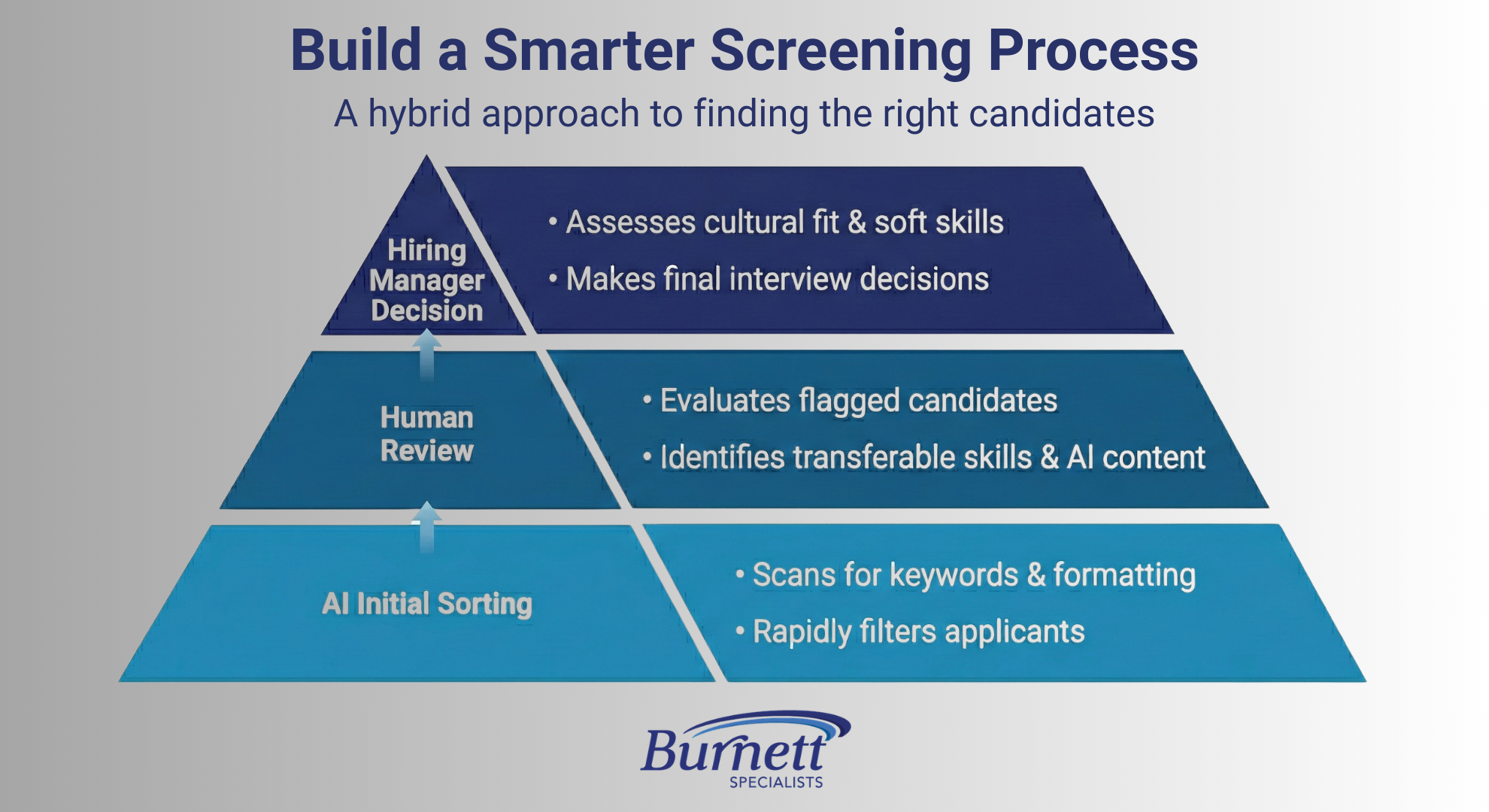
AI screening saves time, especially when you are sorting through hundreds of applications. But if your hiring process depends on AI alone, you are likely losing qualified candidates at the top of the funnel. The best approach combines AI efficiency with human judgment.
Common Problems with AI-Only Screening
- AI algorithms miss context. A candidate with strong transferable skills from a different industry gets screened out because the resume does not match the exact keywords.
- Bias in AI training data can repeat historical hiring patterns, creating discrimination risks that the EEOC has flagged as a growing concern.
- Generative AI is making resumes look the same. When every applicant uses AI to write their resume, it becomes harder for hiring managers to tell candidates apart.
- Contextual analysis is limited. AI cannot assess cultural fit, motivation, or soft skills from a resume alone.
Build a Smarter Screening Process
- Use AI resume screening tools for initial sorting on high-volume roles, then add a manual review step
- Write specific job descriptions with clear requirements so the AI delivers better matches
- Audit your AI tool regularly. Check who is getting filtered out and adjust your criteria
- Have a human reviewer evaluate borderline candidates before they are rejected
- Train your hiring team on AI limitations so they know when to override the system
For more on how state-level AI hiring disclosure laws are shaping the recruitment process, review the latest guidance from SHRM.
How to Spot AI-Generated Resumes
As more job seekers turn to AI tools, watch for these signs during your AI resume review:
- Generic language that could apply to any role in the field
- Overuse of relevant keywords without specific examples to back them up
- Perfectly formatted bullet points with no personality or voice
- Descriptions that mirror the job posting word-for-word
- No specific metrics, project names, or personal details about achievements
An AI-generated resume is not automatically a red flag, but it should prompt deeper human review during the hiring process.
Navigate AI Screening with the Right Partner
AI resume screening is a useful part of today’s job market, but it works best when paired with experienced human recruiters who understand both sides of the hiring equation. An algorithm alone cannot find the right fit for your company culture or help a qualified candidate land the right role.
At Burnett Specialists, we combine advanced technologies with hands-on recruiting expertise to connect businesses with top candidates and help job seekers find roles where they will succeed. As an employee-owned staffing agency with offices across Texas, we bring personal connections and informed decisions to every placement.
Looking to hire? Explore our employer services, from direct-hire placement to temporary staffing.
Searching for your next opportunity? Browse open positions or check out our job seeker resources.
Contact Burnett Specialists today to take the guesswork out of your hiring process or job search.