
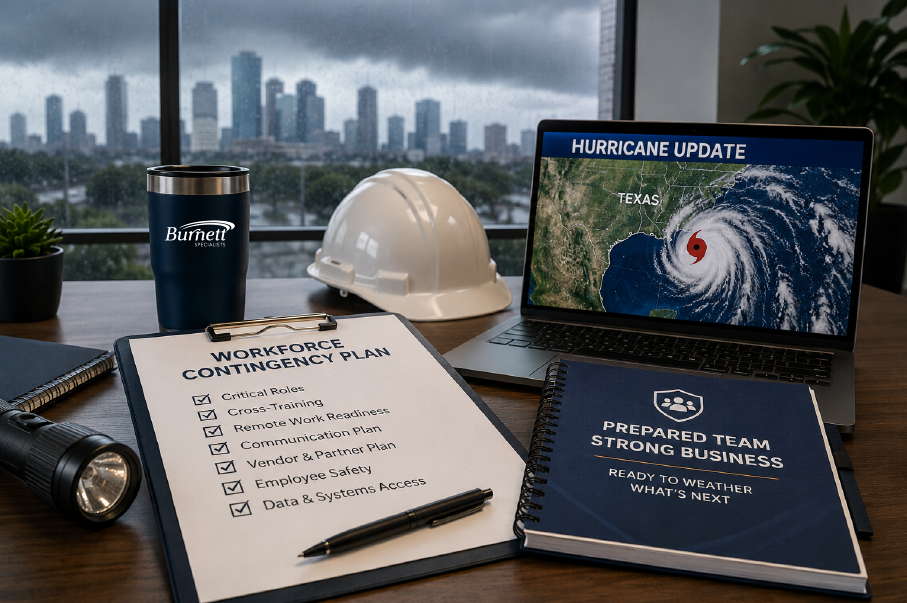
Is Your Workforce Plan Storm-Ready? A Hurricane Preparedness Checklist for Texas Employers
A hurricane does not have to make a direct hit on your office to disrupt your workforce.
Flooded roads, power outages, school closures, unreliable Internet service, evacuation decisions, and interrupted vendor operations can affect employees across a wide area. A building may remain undamaged while the people and systems needed to run the business become temporarily unavailable.
That makes hurricane preparedness more than a facilities or IT responsibility. It is also a workforce-planning issue.
On July 20, 2026, the National Hurricane Center was issuing advisories for Tropical Depression Two in the northeastern Gulf. Forecasts and storm conditions can change quickly, but current Gulf activity is a timely reminder that the most useful decisions are made before employees begin asking whether the office is open, whether they are expected to work, and how the company will respond.
For Texas employers, a storm-ready workforce plan should answer five questions:
- Who has the authority to make decisions?
- Which work must continue?
- How will employees receive reliable information?
- How will pay, timekeeping, and leave be handled?
- Where does the organization need backup coverage?
Clarify Who Makes the Call
Emergency plans often become confusing when several leaders believe they have decision-making authority, or when no one is certain who does.
Before severe weather develops, establish who can:
- Close a workplace or delay opening
- Shift teams to remote work
- Suspend nonessential operations
- Approve emergency schedules or overtime
- Authorize temporary staffing support
- Communicate with employees, customers, and vendors
- Begin the return-to-work process
Designate a primary decision-maker and at least one backup. Larger organizations may need local authority for different Texas offices because conditions in Houston, Austin, Dallas, San Antonio, El Paso, and The Woodlands can vary considerably.
OSHA recommends that emergency planning define the conditions that activate the plan, the chain of command, emergency responsibilities, evacuation procedures, and processes for accounting for personnel.
The practical takeaway is simple: employees should know where decisions come from before a storm is close enough to create uncertainty.
Identify the Work That Must Continue
Not every task carries the same operational consequence during a disruption.
Ask each department to identify the functions that cannot be delayed for several days without affecting employees, customers, compliance, cash flow, or business recovery. Those functions may include:
- Payroll and timekeeping
- Accounts payable and receivable
- Customer or client communication
- IT access and technical support
- Executive and administrative coordination
- Facilities and property operations
- Supply chain and vendor communication
- Contract, legal, or compliance deadlines
- Employee-relations support
For every critical function, document the primary owner, a trained backup, required system access, key contacts, and the maximum acceptable interruption.
This exercise is more useful than simply creating a list of “essential employees.” It helps leaders understand the dependencies behind the work. A payroll specialist, for example, may be available remotely but still unable to complete payroll without approval access, accurate time records, or a functioning banking connection.
Ready.gov recommends using a business impact analysis to identify the processes with the greatest operational and financial consequences and restore those processes first.
Build a Communication Process That Works Without the Office
During a storm, unclear communication creates avoidable stress and operational risk.
Employees need to know:
- Where official updates will be posted
- Who will send them
- When the next update is expected
- How to report that they are safe or unavailable
- Whether remote work is authorized
- What to do when normal systems cannot be accessed
Do not depend on one communication method. Email alone may not be reliable during a power or internet outage. A stronger plan may combine text alerts, email, a recorded information line, a messaging platform, and manager call trees.
Contact lists should be available outside the company network, and managers should understand which employees may need information in another language or through an accessible format.
Ready.gov identifies crisis communication as a central part of business preparedness and recommends determining which audiences need information, what they need to know, and who is responsible for communicating with them.
Messages should also be specific. “Use your best judgment” can leave employees wondering whether an absence will be approved. Tell people what has been decided, what is expected, what remains uncertain, and when they will hear from the company again.
Protect Payroll, Timekeeping, and HR Continuity
Payroll problems can quickly turn a weather disruption into an employee-relations problem.
Confirm that payroll can be processed if the usual administrator, approver, office, or network is unavailable. Employers should consider:
- Remote access to payroll and timekeeping systems
- A trained backup payroll processor
- Secondary approval authority
- Secure access to banking and vendor contacts
- A method for reconstructing missing time records
- Procedures for correcting pay after systems return
- Written guidance for closures, remote work, leave, and emergency schedules
Pay obligations can differ based on employee classification, hours worked, company policy, and the circumstances of the closure. The U.S. Department of Labor explains that the Fair Labor Standards Act generally applies to hours actually worked and does not ordinarily require payment to nonexempt employees for hours they did not work because operations were unavailable. Texas Workforce Commission guidance also addresses weather-related pay and attendance considerations for Texas employers.
Rules affecting exempt employees, leave use, deductions, remote work, and emergency assignments can be more nuanced. Employers should review their policies with qualified HR and legal advisors before a storm rather than improvising after payroll is due.
Organizations that use outside workers should also confirm who is responsible for time approval, employee communication, and payroll processing during an interruption. Burnett’s payrolling support can be a natural resource for employers evaluating how workforce administration will continue when normal operations are disrupted.
Find Coverage Gaps Before They Become Emergencies
A critical process should not depend entirely on one employee.
Cross-training is often the first and most cost-effective way to improve workforce continuity. Department leaders should identify responsibilities that no one else knows how to perform and determine whether another employee can be trained.
Common single-person dependencies include:
- Payroll administration
- Financial approvals
- Customer-service escalation
- IT credentials and system administration
- Executive scheduling and communication
- Vendor coordination
- Compliance reporting
- Property or facilities access
Some gaps cannot be solved through cross-training alone. A company may need additional customer-service coverage, administrative support, financial processing help, IT expertise, or project coordination during preparation and recovery.
That does not mean employers should wait until after the disruption to begin searching. Discuss potential needs with a temporary and contract staffing partner in advance. Determine what work could be transferred, what systems temporary professionals would need, who can approve support, and how quickly onboarding could occur.
The objective is not to add headcount automatically. It is to understand the available options before the business is operating under pressure.
Plan for the Workforce Recovery Period
For many employers, the most difficult workforce challenges emerge after the immediate storm threat passes.
Employees may be dealing with damaged homes, displaced family members, closed schools, unavailable transportation, extended power outages, or insurance appointments. At the same time, the business may face delayed projects, a backlog of customer requests, interrupted financial work, and increased operational demands.
A phased recovery plan may include:
- Continuing remote work where practical
- Staggering schedules
- Reassigning lower-priority work
- Temporarily redistributing responsibilities
- Adding short-term coverage
- Adjusting customer response expectations
- Giving managers clear flexibility guidelines
- Checking facilities before employees return
Employee safety must remain the first consideration. OSHA advises employers to evaluate the specific hazards involved in hurricane response and recovery work and apply appropriate controls, safe practices, and protective equipment.
Employees should not be asked to enter damaged facilities, travel through unsafe conditions, or perform cleanup duties outside their normal scope of work.
Test the Plan Before You Need It
A plan that has never been tested is still an assumption.
Conduct a short tabletop exercise with leaders from HR, payroll, finance, operations, IT, facilities, legal, and customer service. Present a realistic scenario:
- The office loses power on payroll day.
- The primary payroll administrator evacuates.
- Several managers cannot access company email.
- Customer call volume increases.
- The building remains inaccessible for three business days.
Then ask the team to walk through the first 24 hours.
Who makes the closure decision? How are employees contacted? Who processes payroll? Which services continue? Where are passwords, contact lists, and operating instructions stored? Which roles lack backup coverage?
Ready.gov recommends organizing a continuity team, documenting the continuity plan, and testing it periodically. Even a brief exercise can uncover outdated contact information, missing approvals, unclear authority, and staffing vulnerabilities while there is still time to correct them.
Storm-Ready Workforce Checklist
Before the next major weather alert, confirm that your organization has:
- Named primary and backup emergency decision-makers
- Identified critical functions and acceptable downtime
- Assigned trained backups for essential work
- Established more than one employee communication channel
- Verified remote access to HR, payroll, financial, and operational systems
- Reviewed pay, attendance, leave, and remote-work policies
- Identified potential temporary or contract staffing needs
- Created a safe, phased recovery process
- Tested the plan with department leaders
- Updated employee and vendor contact information
A Stronger Plan Starts With the People Behind It
A hurricane preparedness plan is not complete because the facilities checklist is finished or company data has been backed up.
Businesses recover through people: the employees who process payroll, support customers, maintain systems, communicate decisions, coordinate vendors, manage risk, and restart essential operations.
Planning for those responsibilities before a storm helps Texas employers protect employees, reduce confusion, and maintain critical service. It also demonstrates a people-first approach employees are likely to remember long after the weather clears.
Burnett Specialists helps Texas employers strengthen workforce coverage through specialized recruiting, temporary and contract staffing, direct-hire recruiting, temp-to-hire solutions, and payrolling services across a broad range of business functions.
Whether you’re addressing a critical vacancy or preparing backup coverage for changing operational needs, contact Burnett Specialists to discuss your workforce plan.