
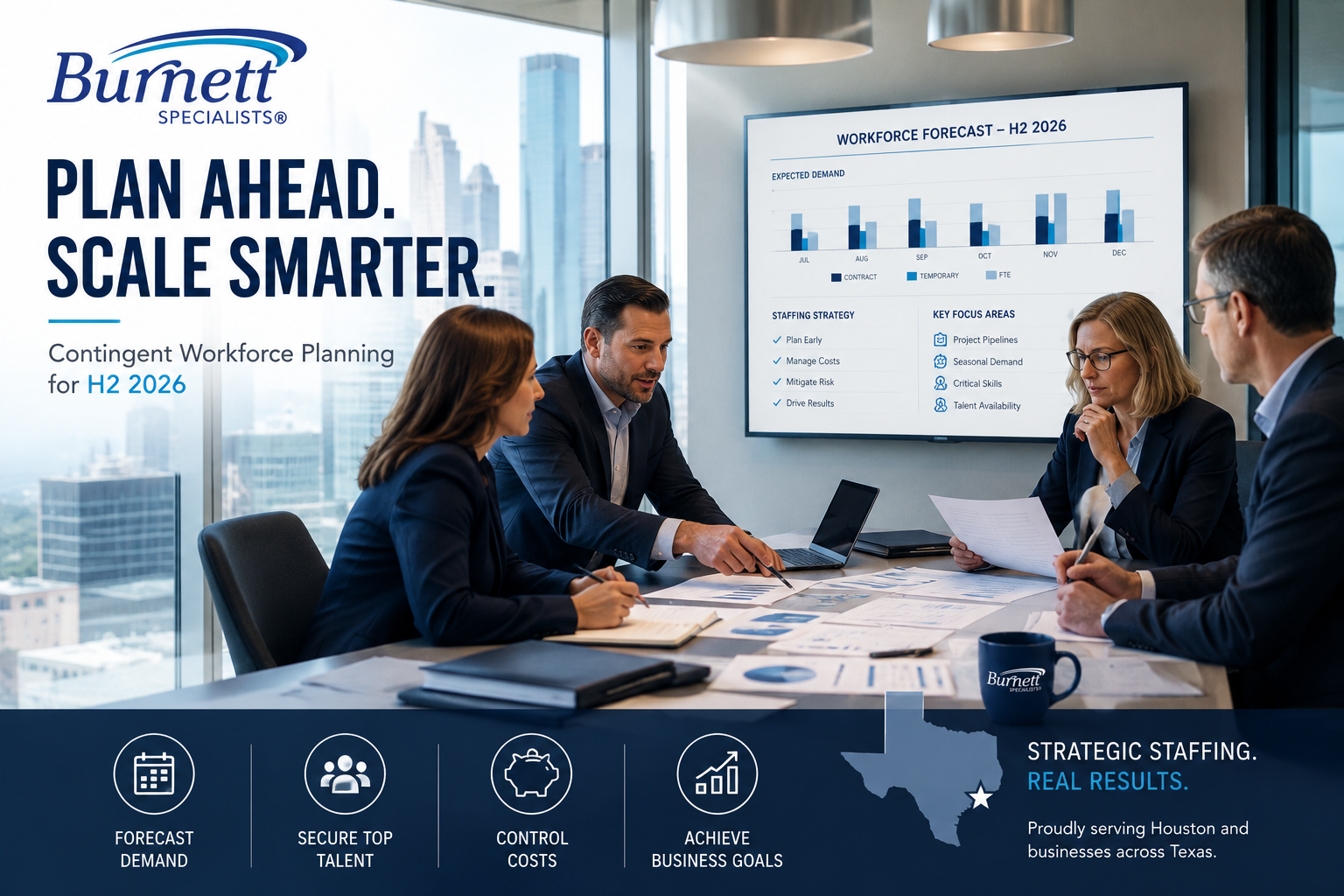
Contingent Workforce Planning: Scaling Without Overextending Your Team
If you manage operations, procurement, or HR for a large Texas employer, you’ve likely experienced this scenario: a critical project accelerates, a department suddenly needs temporary coverage, or seasonal demand spikes faster than anticipated, and by the time you realize the gap, contract rates have climbed, onboarding timelines have stretched, and your team is scrambling to fill roles reactively instead of strategically. That reactive cycle compounds throughout the second half of the year, consuming budget intended for permanent hiring and forcing decisions that prioritize speed over quality.
In our experience working with enterprise operations teams, the organizations that manage contingent workforce fluctuations smoothly rather than absorb repeated cost overruns consistently rely on one factor: planning that happens 60 to 90 days before demand actually materializes. For enterprise teams facing H2 2026, that window is narrower than it appears, and the stakes are higher. Project pipelines are taking shape now. Seasonal patterns from prior years are becoming visible. Attrition forecasts are emerging from your data. Yet many operations teams haven’t yet mapped out what their temporary and contract staffing posture actually needs to be.
This guide addresses how to build a contingent workforce plan for the second half of 2026 that balances flexibility with cost discipline, prevents reactive hiring chaos, and aligns your contract and temporary staffing strategy with your permanent headcount capacity.
Why H2 2026 Demands Contingent Workforce Planning Now
Most enterprise organizations finalize budget allocations and headcount plans during Q1 and early Q2. By the time Q3 arrives, those permanent FTE allocations are largely locked. What often remains undefined, or defined too loosely, is how temporary, project-based, and seasonal staffing will fill the gaps between those permanent positions and actual operational demand.
Consider a 450-person supply chain and operations firm in Houston that discovered in mid-July 2025 that three contract roles in supply chain coordination went unfilled because contingent workforce planning wasn’t integrated into the annual business cycle. By that point, available contractors in their specialized skill areas were booked, bill rates had risen 18% above early-summer pricing, and onboarding took longer because staffing firms were less flexible during peak season. The budget line item for contract staffing, which should have been reserved for strategic flexibility, was consumed entirely by reactive emergency hiring. This scenario, repeated across industries and organizations that don’t plan contingent needs proactively, shows how the cost impact extends beyond higher bill rates alone. Rushed placements often produce misaligned hires. Onboarding velocity slows because teams are too busy to integrate new people properly. And permanent staff burn out from carrying heavier workloads while contingent roles sit unfilled, which then drives unexpected attrition in your FTE base, exactly the opposite outcome of what temporary staffing is supposed to prevent.
For large Texas employers, the competitive labor market compounds these pressures. Specialized talent in accounting, IT, supply chain, sales, and legal roles fills faster in H2 than in Q1, partly because other organizations are also planning reactively and bidding up competition. Firms that forecast and plan early capture candidates before competition intensifies. Those that wait pay the price in fill time, cost, and quality mismatches.
Forecasting Contingent Workforce Demand for H2 2026
Effective contingent workforce planning starts with demand signals, not with historical staffing budgets. Your staffing needs in H2 depend on what’s actually happening in your business, not on what happened last year. Pull signals from three sources:
-
Project pipelines and timelines: Which initiatives launch or accelerate in Q3 or Q4? Software implementations, facility expansions, customer onboarding surges, or compliance projects often spike in the second half because organizations front-load planning in the first half. Map the staffing intensity of each initiative and estimate how many temporary or specialized contract resources those projects will require.
-
Seasonal and cyclical demand patterns: Certain roles in customer service, event support, accounting (month-end and year-end close cycles), and logistics consistently intensify in specific H2 months. Pull your contingent headcount history from H2 2024 and H2 2025 to identify which months typically spike and which departments drive those spikes. This historical pattern is your baseline demand forecast.
-
Anticipated FTE attrition: Voluntary turnover often accelerates in Q3 and Q4 as employees make year-end career moves. Estimate realistic attrition rates by department and role type. Some of that attrition you’ll backfill with permanent hires; some you’ll cover temporarily with contingent staffing while you conduct a full search.
Once you’ve gathered those signals, segment your contingent staffing needs by type, because different workforce categories require different lead times and vendor strategies:
-
Short-term temporary coverage (one to four weeks, often for vacation coverage or emergency backfill) typically requires 2 to 3 weeks lead time.
-
Project-based contractors (3 to 12 months, specialized roles tied to a specific initiative) typically require 4 to 8 weeks to identify, vet, and onboard quality candidates.
-
Contract-to-hire talent (intended eventually as permanent FTE) typically requires 6 to 10 weeks of planning and vetting because you’re screening not just for immediate capability but also for culture and long-term fit.
Align your contingent workforce forecast with your business unit planning cycles; don’t treat it as a separate HR exercise. Operations leaders, project managers, and finance should all feed signals into a centralized contingent staffing forecast that gets updated quarterly. That integration transforms contingent staffing from a reactive cost center into a strategic planning tool that actually anticipates business demand.
Balancing Internal FTE Capacity Against Contractor Flexibility
One of the most common mistakes enterprise teams make is assuming that adding contingent workers reduces strain on permanent staff. In practice, the opposite often happens if the contingent workforce isn’t structured intentionally. Permanent employees end up onboarding, supervising, and backstopping contractors because the contracting relationship doesn’t include those activities. That overhead consumes the productivity gains you expected from bringing in external resources.
The real use of contingent staffing comes from clarity about what permanent staff should be doing versus what temporary or contract resources should own. Define that boundary explicitly for each contingent role:
-
If a contractor is backfilling a departed employee for three months, permanent staff should spend the first week on onboarding, then step back. Contractors should own the work independently, not be semi-supervised by overloaded permanent teammates.
-
If a project requires specialized skills that your permanent team doesn’t have, say, a specific software implementation or compliance expertise, the contractor should operate relatively autonomously in that domain. Permanent staff should interface on strategy and deliverables, not become apprentices to the contractor.
-
If your goal is to surge capacity temporarily, contractors should absorb additional volume immediately, not require weeks of ramp-up that delays the benefit of bringing them aboard.
This isn’t about being cold toward contractors; it’s about being realistic about the economics. Every hour a permanent employee spends training or supervising a contractor is an hour not spent on value creation for the company. If you’re hiring contingent staff to reduce permanent team strain, those resources need to be truly independent contributors within their scope, not perpetual mentees.
Conversely, don’t use contingent staffing as a replacement for permanent team capacity in roles or functions where knowledge continuity matters. IT security, compliance, strategic sales, and senior operational roles shouldn’t routinely run on contingent headcount because you lose institutional memory, customer relationships, and the investment continuity that permanent employees provide. Contingent staffing excels at handling surge, filling specific skill gaps, and managing time-sensitive projects. It’s a poor substitute for permanent capacity in roles where your organization’s competitive advantage depends on tenure and accumulated expertise.
Contingent-to-Permanent Workforce Ratios and What They Actually Mean
You’ll find recommendations in industry literature suggesting that contingent workers should make up somewhere between 15% and 30% of a total workforce, depending on industry volatility. Those benchmarks exist, but they’re most useful as a sanity check, not as a prescriptive target. A financial services firm in a volatile year might run 25% contingent. A manufacturing company in a stable product cycle might be comfortable at 10%. A professional services firm that staffs client engagements might run 40% or higher. The ratio that’s right for your organization depends on your business model, not on an industry average.
What matters more than the absolute ratio is understanding what your contingent staffing composition actually is and why. Too many enterprise organizations discover mid-year that they’ve drifted to 35% contingent headcount not because that was strategic, but because reactive hiring accumulated gradually. That drift often signals a problem underneath: maybe permanent FTE budgets are frozen while demand keeps growing, maybe hiring cycles are too slow to meet business needs, or maybe certain departments have learned to route around official headcount approvals by hiring contractors instead.
For H2 2026 planning, establish a target contingent ratio by department or function that reflects your business model and capacity strategy. If you determine that your supply chain operations should run 20% contingent (meaning 20 of every 100 staff in supply chain are temporary or contract), translate that into actual headcount. If you forecast a contingent pool of 15 people based on seasonal demand and project needs, and that represents 20% of your supply chain workforce, you know your permanent supply chain FTE should be 75. That discipline prevents drift and keeps contingent staffing aligned with strategic intent rather than accumulated accident.
One trade-off worth acknowledging: maintaining contingent staff at a strategically intentional level requires saying no to reactive hiring opportunities. When a department head wants to hire a contractor for an undefined role with uncertain duration, sticking to your contingent staffing plan means sometimes declining that request and instead filling the need through your planned contingent pool or by waiting for permanent FTE capacity to open.