Voices Of Success - Burnett Specialists

Testimonials

Find A JobHire Talent

Voices of Success: Real Feedback from Our Client and Candidate Community

Discover authentic stories of growth and success from our clients and candidates about the unmatched staffing and recruiting services that propelled their careers or company forward.

From Our Clients
Client Testimonials

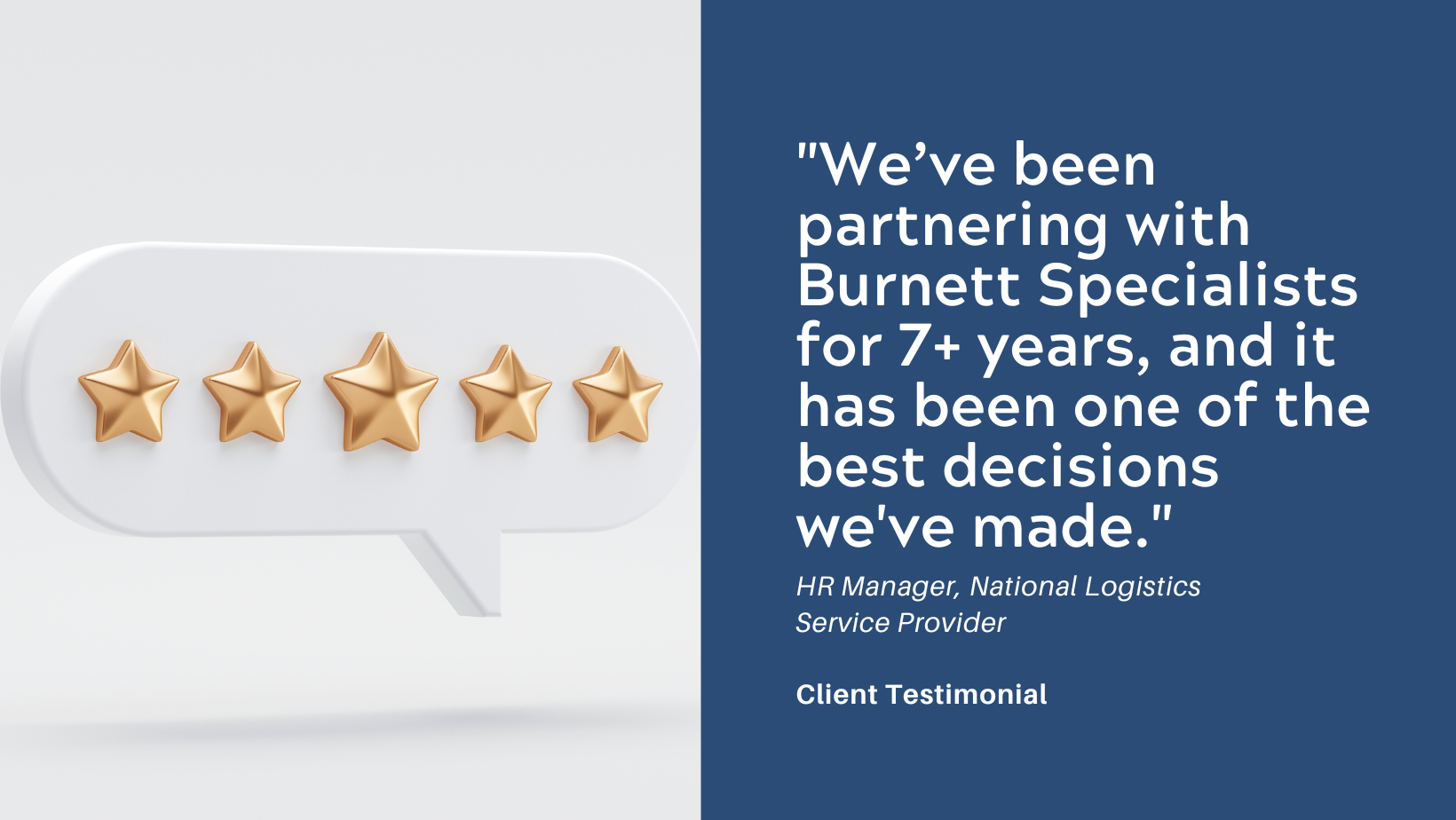
Client Testimonial – HR Manager, National Logistics Service Provider

"We’ve been partnering with Burnett Specialists for 7+ years, and it has been one of the best decisions we've made. Our industry often calls for “speedy” hires/replacements, and often times very short notice of a position to be filled. Burnett has not only provided the quality we look for in our employees, but also the specialized expertise that goes with it. No matter the time of day, which at times is late in the day, Burnett always manages to get the desired candidates in the timeframe required. Most importantly, we’ve established an excellent working relationship with Burnett, and are very excited to continue in this partnership. Thanks to the entire Burnett team for your dedication and professionalism. You guys are the best!"

-Human Resources Manager, Logistics & Supply Chain

Client Testimonials

Client Testimonial – Corporate Recruiter, Major Oil Corporation

"Burnett Specialists has always come through to assist in filling positions for our teams.  There are times when we have a very small window to onboard a candidate, and Burnett will step up to provide support. Additionally, our territory manager Catherine Young, never fails to reach out regarding our employment needs. Thank you, Burnett for excellent teamwork!"

-Corporate Recruiter, Oil & Gas Industry

Client Testimonials

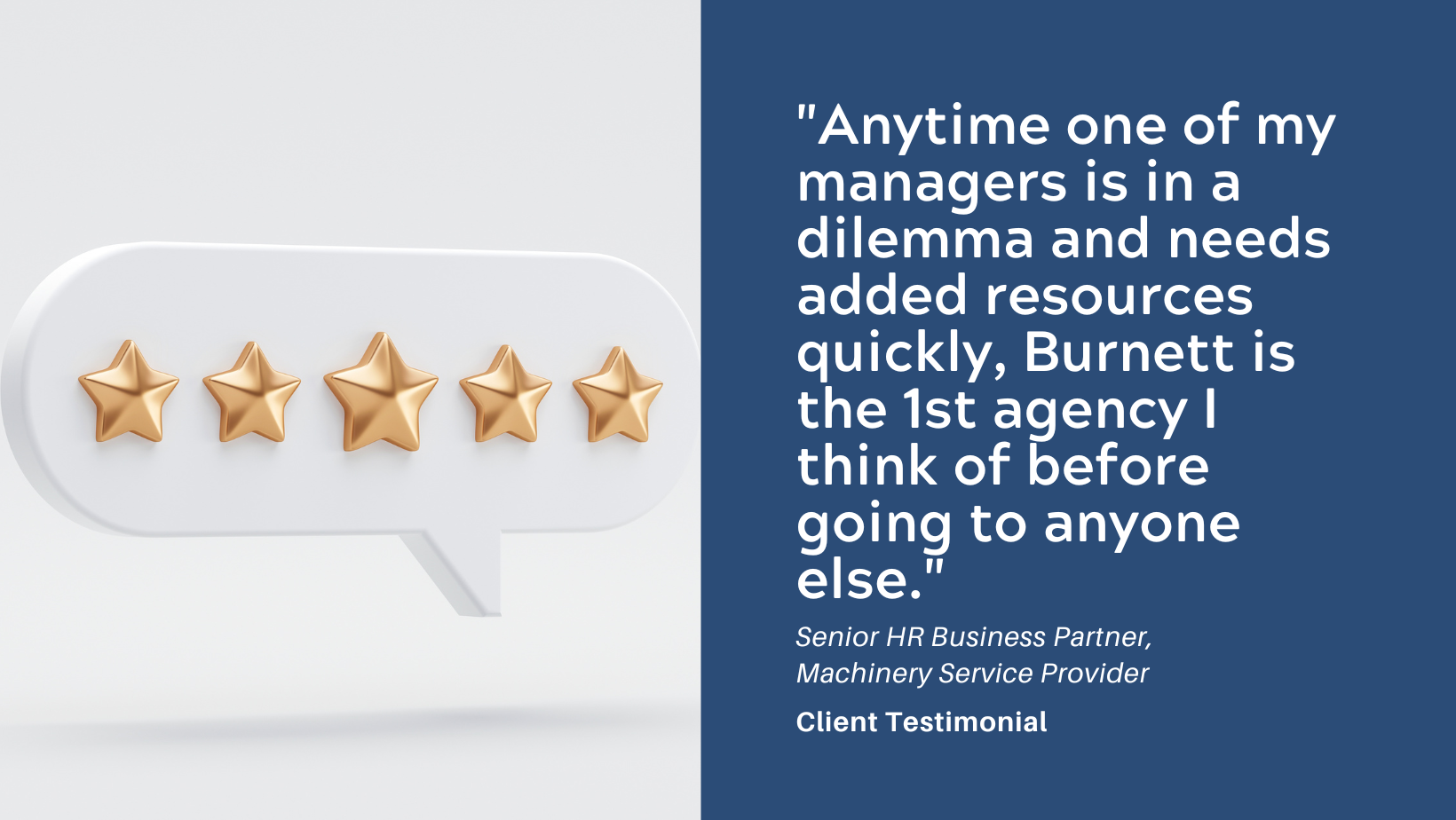
Client Testimonial – HRBP, Machinery Services Company

"I have worked with Burnett for over 17 years since working for my previous employer and now with my current employer.  Burnett has always been so helpful in staffing our Warehouse, Shop and Office roles.  Anytime one of my managers are in a dilemma and needs added resources quickly, Burnett is the 1st agency I think of before going to anyone else.  I even have a few of my management peers going to Burnett directly themselves whenever they need extra resources because they know they can count on their firm for delivering candidates and completing the pre-employment checks in ample time.  We ❤ Burnett Specialists!"

- Senior HR Business Partner, Machine Services

From Our Candidates
Candidate Testimonials

The 90-Day Hiring Window: Why June Hiring Decisions Determine Your Q3, Q4 Productivity

The 90-Day Hiring Window: Why June Hiring Decisions Determine Your Q3, Q4 Productivity

If you're a CFO, COO, or operations director, you've felt this pattern: Q4 arrives with understaffed teams, delayed projects, and burned-out employees carrying workloads meant for two people. The instinct is to blame seasonality or bad luck. But the real culprit is usually a hiring decision, or a decision to wait, made eight weeks earlier in June.

The mechanics are straightforward. A new hire typically needs 60 to 90 days to reach meaningful productivity in professional or technical roles. That ramp period includes onboarding, system access, role-specific training, shadowing, and ramping to independent contribution. None of these phases compress without quality loss. A candidate you hire in July doesn't arrive at full capability until late September or October. Delay that hiring decision to August, and you're looking at November or December before that person is genuinely contributing at the level you need.

For organizations in competitive Texas markets, Houston, Dallas, Austin, San Antonio, that 90-day window isn't academic. It's the difference between entering your peak business season fully staffed and entering it one, two, or three people short. The financial and operational consequences compound faster than most organizations anticipate.

How the 90-Day Ramp Maps to Your Fiscal Calendar

Here's where the calendar becomes critical. Many businesses experience their highest revenue-generating periods, largest project deliveries, or peak operational demands in Q3 and Q4. But the staffing decisions that determine whether you meet those demands happen months earlier. A June hiring decision sets the trajectory for September and October performance.

In our experience working with operations teams across Texas, a pattern emerges consistently: a mid-sized manufacturing operation in the Dallas area identifies the need for two additional operations coordinators in late May. The hiring manager requests candidates by early June. If the recruiting process moves efficiently, candidate screening, interviews, offer, and acceptance, you might have two new hires starting July 1st. By early October, they're at maybe 70 to 80 percent productivity. By late October, they're genuinely helpful. Useful, but not yet independent.

Now reverse that scenario. The same hiring need is identified, but the company decides to wait. "Let's see if we can manage with the current team through the summer," a common refrain. By late August, when workload pressure becomes undeniable, the recruiting process restarts. Candidates who were available in June have accepted other roles. The talent pool is thinner. The hiring process stretches to eight or nine weeks. A new hire doesn't start until late September or early October. By the time they're useful, Q4 is nearly finished. The entire quarter's productivity gain is lost.

This isn't theoretical. Roles with higher complexity - accounting management, operations, technical specialties, client-facing sales positions - carry longer ramp periods, sometimes 120 days or more. The delay compounds with complexity.

The Under-staffing Cost During Peak Business Seasons

Delayed hiring doesn't eliminate costs; it redistributes them. Your existing team absorbs the overflow. In Q3 and Q4, when output demand peaks, that redistribution becomes acute.

Consider what happens operationally. A finance director managing accounts receivable and month-end close normally handles a defined portfolio. If the role was supposed to be supported by an additional analyst hired in June, but that analyst doesn't arrive until November, the director is running the entire function solo for four months. That's not efficiency; that's survival mode. Mistakes increase. Accuracy declines. Deadlines slip. Client communication deteriorates.

The human cost is equally real. Teams carrying workload beyond capacity don't just experience stress, they experience the kind of burnout that triggers departures. An employee who leaves in November or December during your peak season doesn't just create a new vacancy; they leave at the exact moment when backfilling that person is most challenging. You've gone from one understaffed role in June to two understaffed roles in December, and the team that absorbed the June shortfall is now scattered or gone.

Revenue impact is measurable in client-facing and revenue-generating roles. A sales team running at 80 percent headcount through Q3 and Q4 doesn't close 80 percent of the deals it could have. The math doesn't work that way. A team member covering for an absent colleague isn't prospecting. Quota attainment suffers. Customer relationships atrophy. In competitive Texas markets where account-based sales or relationship continuity matters, that's not just a quarterly miss, it's a relationship loss that affects future quarters as well.

The damage also outlasts the vacancy itself. A team that operates at burnout capacity for a quarter doesn't magically return to normal productivity the moment a new hire arrives and gets up to speed. They're depleted. Morale is damaged. Institutional knowledge about what was de-prioritized during the crunch doesn't get recovered automatically.

Texas Market Dynamics and Mid-Year Hiring Competition

The Texas labor market has its own seasonal rhythm that amplifies the stakes of June hiring decisions. Mid-year is when talent competition peaks. Candidates who were available in April and May have been hired. Organizations that made quick decisions in Q1 and Q2 have already filled their pipelines. By late June and July, the remaining candidate pool is thinner and more likely to be passive or less motivated. At the same time, the number of open positions across Texas markets - Houston, Dallas, Austin, San Antonio - typically increases heading into the second half. More employers competing for fewer candidates means longer time-to-fill, lower candidate quality, or higher offer escalation.

Companies that wait until August or September to address a June hiring need discover this dynamic directly. The candidates who were available are gone. The recruiting timeline stretches. The offer negotiations become more complex. Your start date for a November-intended hire might slip to December, effectively writing off that role's contribution for the year.

A Proactive Framework for Mid-Year Staffing Decisions

The solution isn't reactive hiring or panic recruiting in August. It's forward-looking staffing planning tied to your business calendar, not your current headcount.

Start by mapping your Q3 and Q4 operational needs to your current team's capacity. Which roles are critical to peak season performance? Which functions have zero slack? In those areas, make staffing decisions in May and June, not August and September. A hiring process started in May that concludes with a July start puts a new hire at productive contribution right as your peak season accelerates.

Second, be realistic about ramp time for complex roles. If your organization has historical data on how long it takes a new hire in a specific role type to reach full productivity, use that data. Finance roles typically require 90 to 120 days. Sales roles with a hunting profile require similar timelines. Operations and client-facing roles are often in the 90-day range. Don't assume 30 or 60 days unless your own data supports a faster ramp. A hiring timeline built on wishful thinking about ramp speed is a hidden recruiting failure.

Third, maintain candidate pipelines for roles that recur or are seasonal. For call centers, convention and event staffing, and other functions with cyclical demand, building relationships with candidate pools before you need them accelerates time-to-fill when demand peaks. Rather than starting from zero in August, you already have screened, known candidates who can move quickly.

Fourth, invest in getting first-pass hiring right. Candidate quality at the first interview stage directly affects time-to-productivity. If 80 percent of your initial candidates are mismatched, the entire process bogs down in screening and rejection. Staffing and recruiting strategies built around role-specific screening and culture fit at intake reduce downstream friction and accelerate the path to productive contribution.

Finally, acknowledge that hiring isn't a binary choice between "immediate" and "wait." It's a timeline equation. A hiring decision in June for a July start assumes a seven-to-eight-week recruiting, interview, and onboarding process. A decision in late July for a September start requires an even longer runway to account for summer schedules and candidate availability. Map backward from your peak business season, and staff accordingly.

The Real Cost of Getting This Timing Wrong

The financial math of delayed hiring is often hidden because it spreads across line items. There's no single "cost of waiting" entry on a spreadsheet. Instead, there's slightly higher overtime in Q3. A few projects that finish two weeks late in Q4. Customer satisfaction scores that dip in October. Employee turnover that spikes in November. When you add these up - lost productivity, team attrition, delayed project timelines, customer relationship risk - the cost of a delayed June hiring decision often exceeds the cost of hiring itself.

This is especially true for professional roles in legal, accounting, operations, and sales, where the individual contributor's absence directly impacts output, revenue, or client relationships. A vacant operations role in a growing company isn't a vacancy; it's a productivity leak that widens with each quarter.

The counterpoint is worth acknowledging: hiring too quickly or hiring the wrong person is also costly. Rushing a June hiring decision to meet a hypothetical September need, only to bring on someone who isn't capable, defeats the purpose entirely. The framework above - realistic ramp timelines, strong first-pass screening, role-specific candidate pipelines - isn't about hiring fast; it's about hiring deliberately, on a timeline that aligns with your business cycle.

Moving From Planning to Execution

If you're reading this in May or early June, the timing window is open. Audit your current team's capacity against your Q3 and Q4 operational plans. Identify roles where you're running lean. For those roles, start the hiring process now, not in August. Calculate your realistic time-to-productivity for each role type, and work backward from your peak business season to determine your start date target. Build your candidate screening and interview process around role-specific competencies and performance indicators, not just resume keywords or previous job titles.

Contact us today

Candidate Testimonials

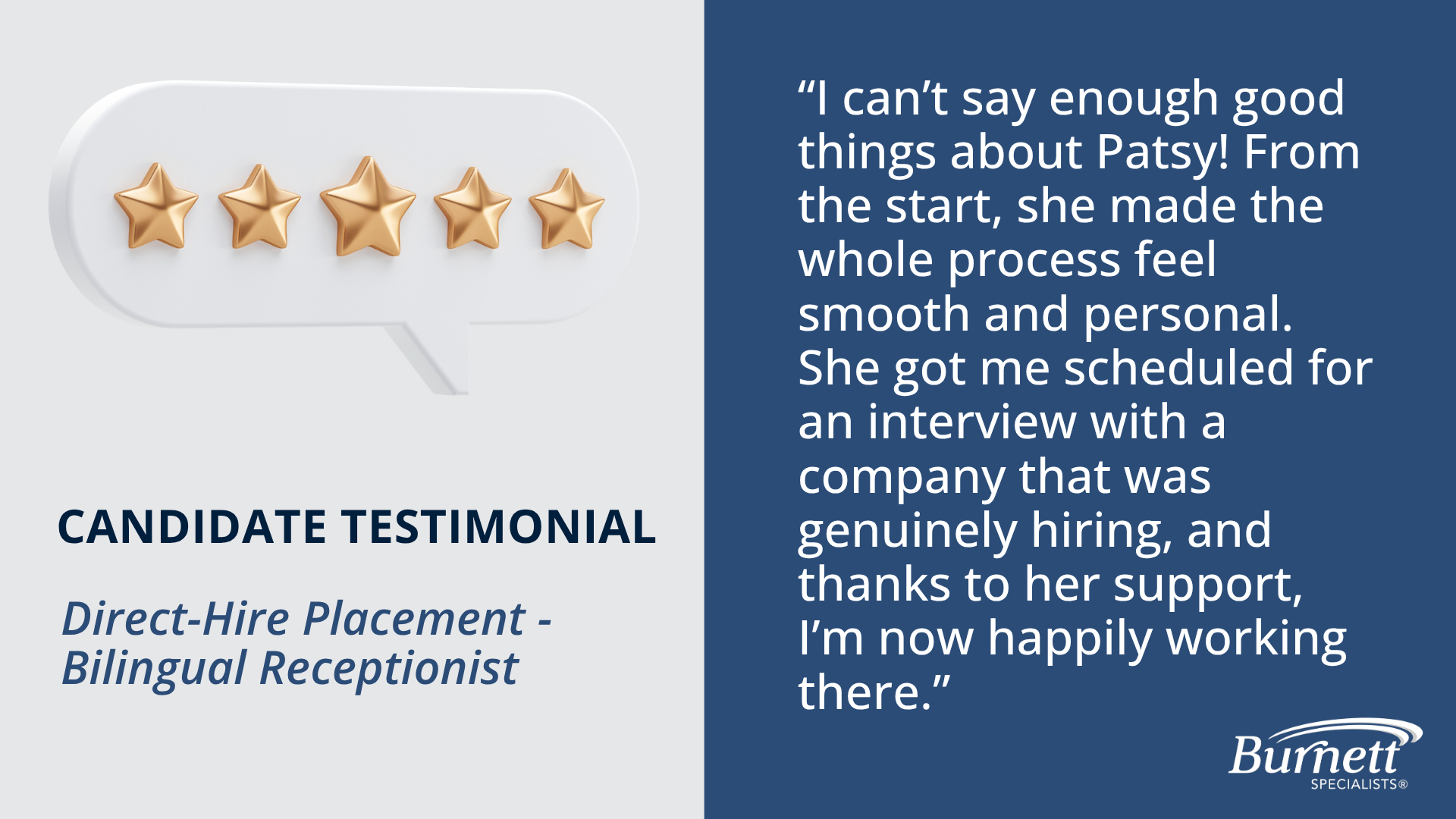
Candidate Testimonial – Direct-Hire Placement, Bilingual Receptionist

"I can’t say enough good things about Patsy! From the start, she made the whole process feel smooth and personal. She got me scheduled for an interview with a company that was genuinely hiring, and thanks to her support, I’m now happily working there. What really stands out is her communication — Patsy consistently follows up and makes sure you’re heard every step of the way. She listens carefully and truly cares about connecting the right people with the right opportunities. Working with her has been an excellent experience, and I’m grateful for her dedication and professionalism."

-Karina A. - Direct-Hire Placement, Bilingual Receptionist

Candidate Testimonials

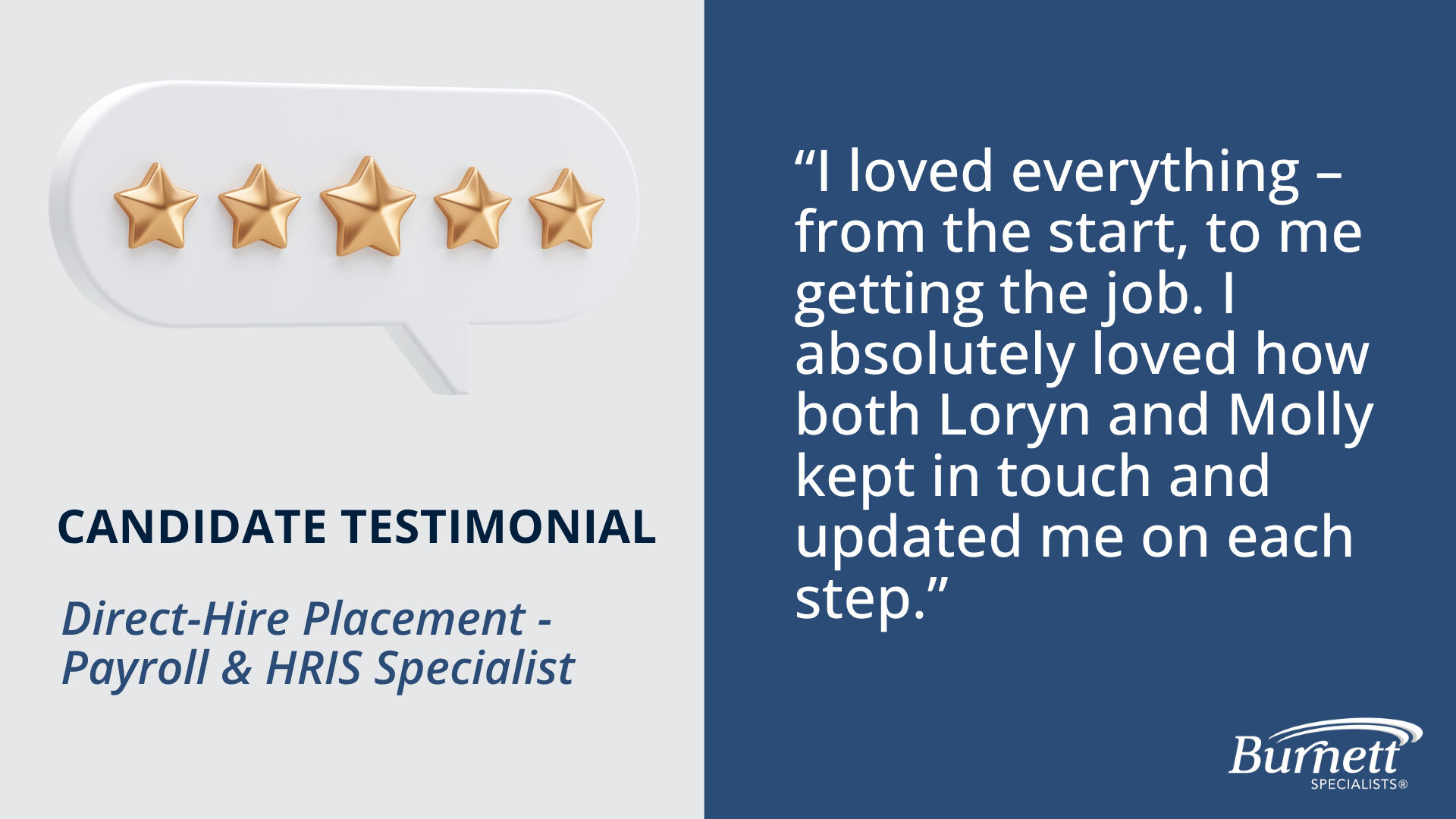
Candidate Testimonial – Direct-Hire Placement, Payroll & HRIS Specialist

“Everything was perfect! Molly Gutierrez and Loryn Montalvo are the sweetest and absolutely the best at what they do. I loved everything -- from the start, to me getting the job. I absolutely loved how both Loryn and Molly kept in touch and updated me on each step."

-Mariam M. - Direct-Hire Placement, Payroll & HRIS Specialist
Candidate Testimonials

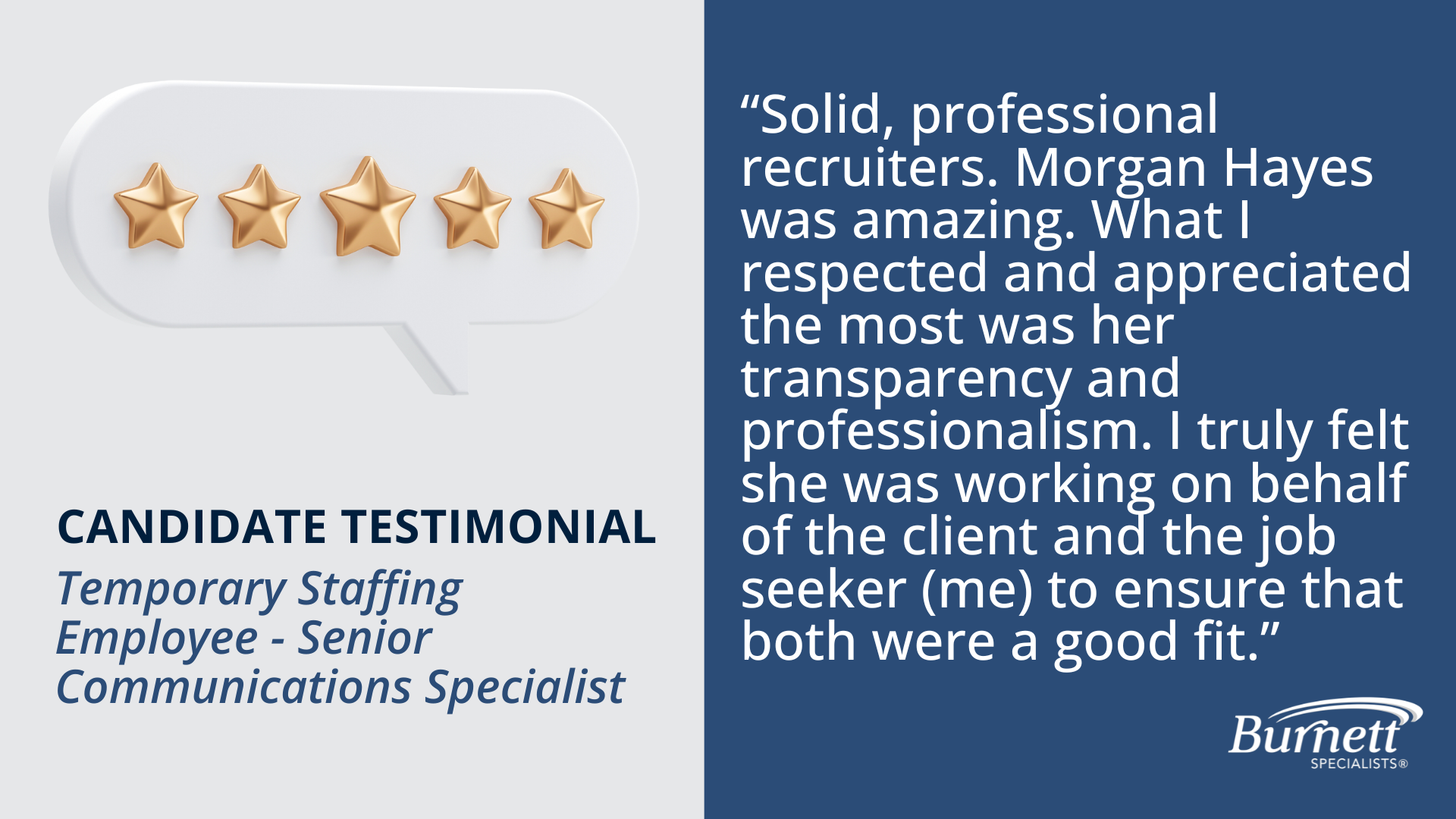
Candidate Testimonial – Sr. Communications Specialist – Temp Placement

"Solid, professional recruiters. Morgan Hayes was amazing. What I respected and appreciated the most was her transparency and professionalism. I truly felt she was working on behalf of the client and the job seeker (me) to ensure that both were a good fit."

-Andrew G. - Temporary Staffing Employee - Senior Communications Specialist

Candidate Testimonials

Candidate Testimonial – Direct-Hire Placement, Office Manager

"I truly appreciated the professionalism, transparency, and consistent communication throughout the process. Everything was well organized, and I always felt informed and supported at each step. Working with Krista Clements was a highlight of the experience. She was extremely attentive, responsive, and proactive, and her guidance made the process smooth and reassuring. Her approach reflects a genuine commitment to both the candidate and the client, which I found very impressive. Overall, it was a very positive and well-managed experience with Burnett Specialists."

-Márcia C. - Direct-Hire Placement, Office Manager
Candidate Testimonials

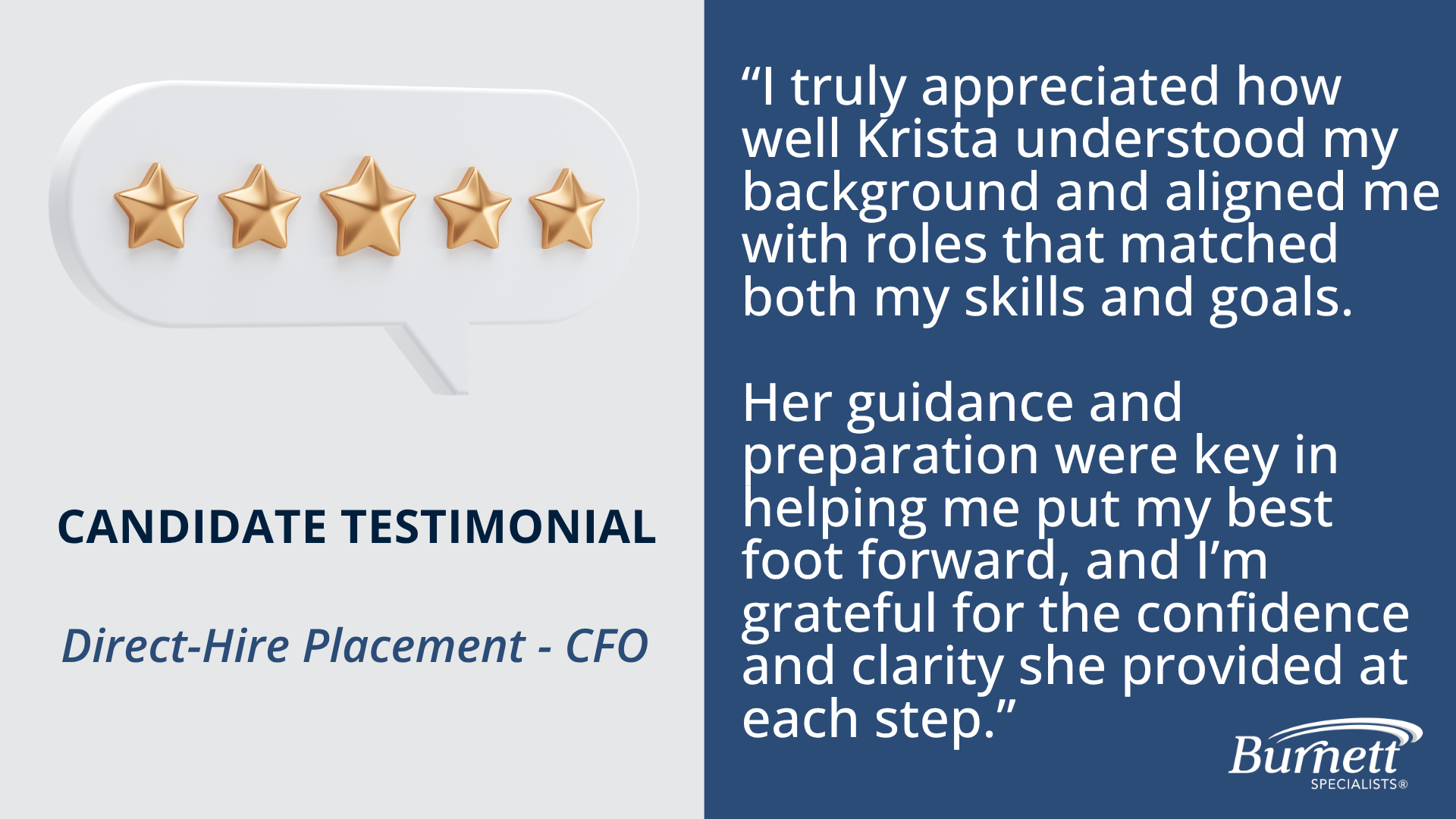
Candidate Testimonial – Direct-Hire Placement, CFO

"Krista's energy, professionalism, responsiveness, and insight set her apart. She reached out after finding my profile in the database, and within just two and a half weeks, I landed the job. Krista's ability to clearly communicate opportunities, provide timely updates, and offer thoughtful insights made the experience smooth and stress-free. I truly appreciated how well Krista understood my background and aligned me with roles that matched both my skills and goals. Her guidance and preparation were key in helping me put my best foot forward, and I’m grateful for the confidence and clarity she provided at each step."

-Matthew D. - Direct-Hire Placement - CFO

Candidate Testimonials

Candidate Testimonial – Direct-Hire Placement, Litigation Secretary

"I worked with Ashley Craddick for my job search, and I would highly recommend her to anyone looking for a new position in the legal field. She was extremely knowledgeable, responsive, and kind through every step of the process. Thank you to Ashley for helping me find my amazing new job!"

-Caitlin Z. - Direct-Hire Placement, Litigation Secretary
Candidate Testimonials

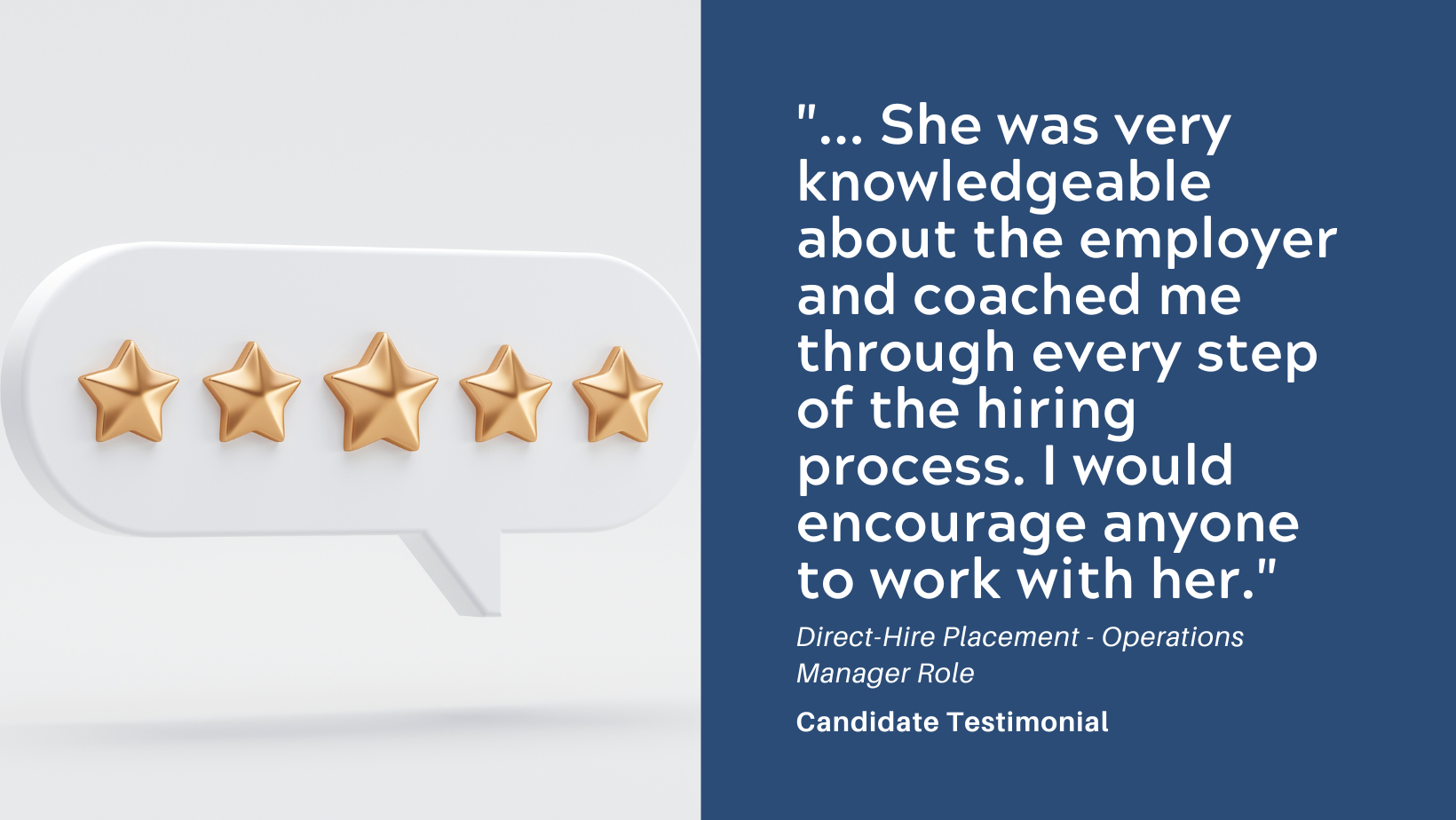
Candidate Testimonial – Direct-Hire Placement, Operations Manager Role

"Larissa was personable and just an overall amazing person to work with. She was very knowledgeable about the employer, and coached me through every step of the hiring process. I would encourage anyone to work with her.

-Matthew R. - Direct-Hire Placement - Operations Manager

Candidate Testimonials

Candidate Testimonial – Direct-Hire Placement, Sales Client Relations Role

"I felt that my recruiter added a personal touch to the process. Prompt return calls, always there to answer questions and getting me the optimum offer and package. She really represented me well and promoted my strengths to the client. I can honestly say that I would feel the same even if I didn't land the position."

-Timothy B. - Direct-Hire Placement - Client Relations / Business Development

Candidate Testimonials

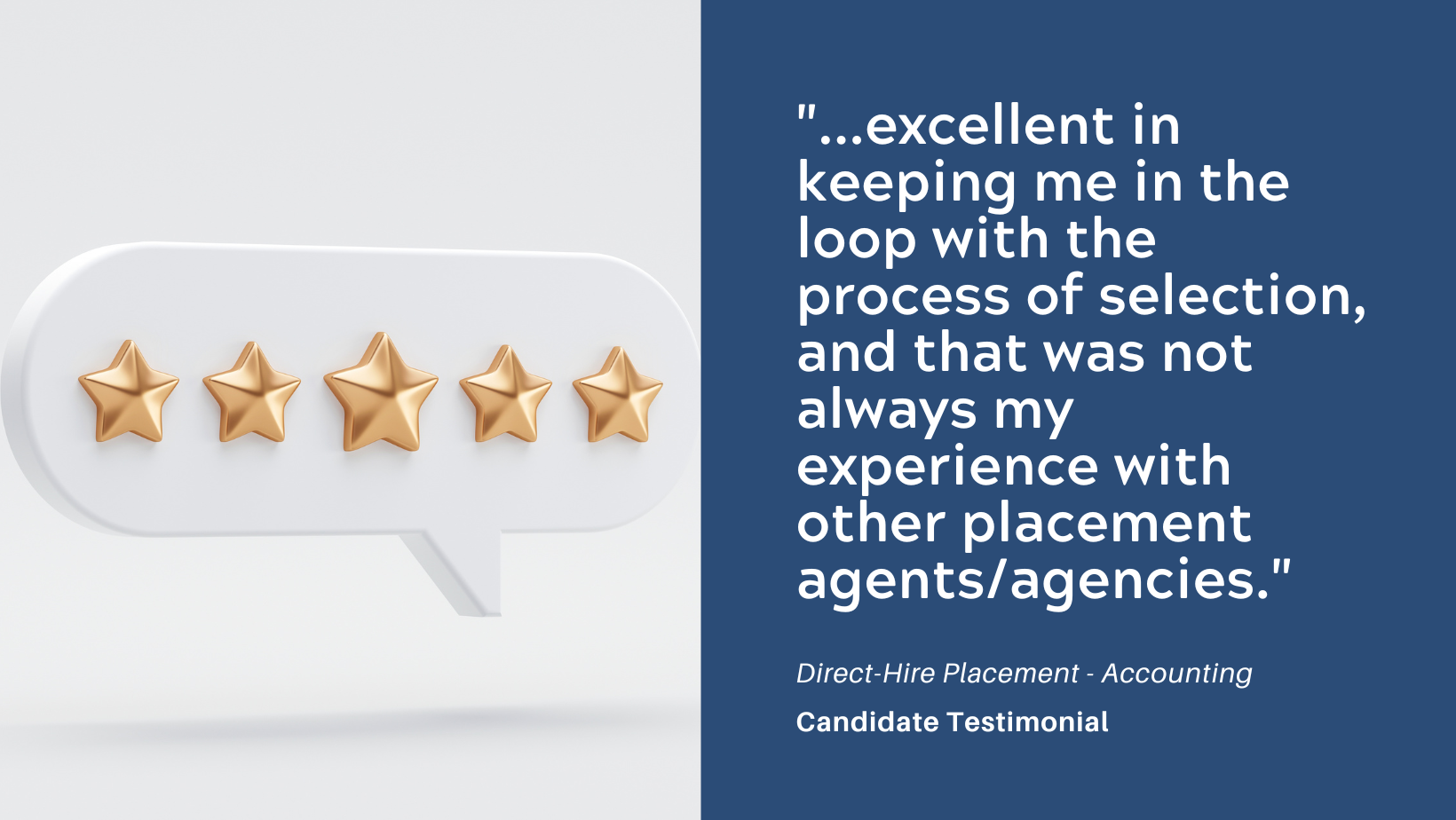
Candidate Testimonial – Direct-Hire Placement, Accounting Manager Position

Molly and Madison were excellent in keeping me in the loop with the process of selection, and that was not always my experience with other placement agents/agencies. They went over and above my expectations.  You guys are awesome!!!

-Denise L. - Direct-Hire Placement - Accounting Management Position

Need to hire someone?  Become a Burnett Specialists client.

View All Open Positions

Visit our career portal to view and apply for open accounting & finance positions near you!